
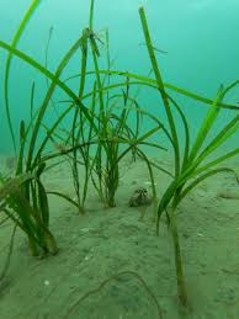
Seagrass, as the name suggests, looks like grass growing beneath the sea, but there is far more to it than that. Seagrass is the only flowering plant able to live fully in saltwater. Like land plants, it has roots, stems and leaves and reproduces through flowers and seeds.
Pembrokeshire Coastal Forum, 2020
Here in Pembrokeshire, we have two species of seagrass: Eelgrass (Zostera marina) and Dwarf eelgrass (Zostera noltii). Dwarf eelgrass is the smaller of the two species and is usually found in intertidal areas, exposed at low tide. Eelgrass is a subtidal species and grows in deeper water, reaching depths of up to five metres.
Seagrass is a really cool ocean habitat and is super important for a load of reasons. The grass is always greener when seagrass is about and now, I’m going to tell you why…
Despite covering only around 0.1% of the ocean floor, seagrass stores an estimated 10 to 18% of the ocean’s carbon. This makes seagrass meadows one of the most important natural carbon sinks, helping slow climate change by trapping carbon before it is released into the atmosphere.
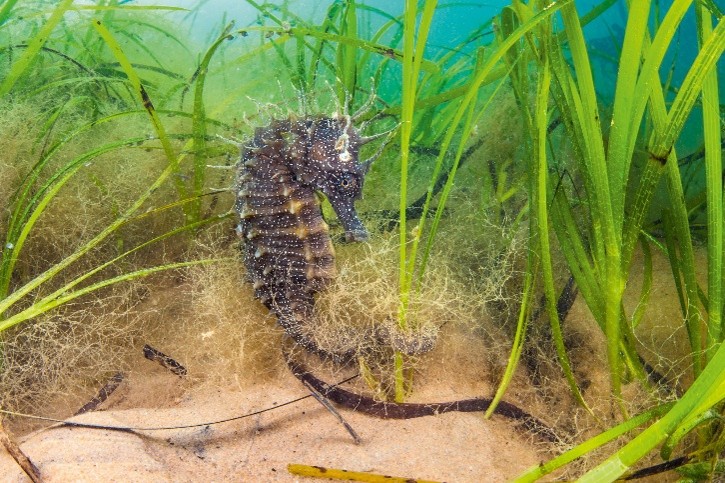
Not only is seagrass important for carbon sequestration but they also act as underwater nurseries, providing shelter and feeding grounds for juvenile fish and other marine life. Many commercially important species, including cod, plaice and herring also rely on seagrass meadows. These meadows are also home to some incredible marine species, including seahorses, cuttlefish, pipefish and stalked jellyfish.
Future Publishing Limited, 2021
The benefits do not stop there. Seagrass also plays a major role in protecting our coastlines. Dense meadows reduce the energy of waves before they reach the shore, helping limit coastal erosion. Their root systems stabilise sediments on the seabed, keeping the seafloor in place and improving water clarity. Seagrass even helps filter pollutants from the water, making coastal environments healthier for both wildlife and people.
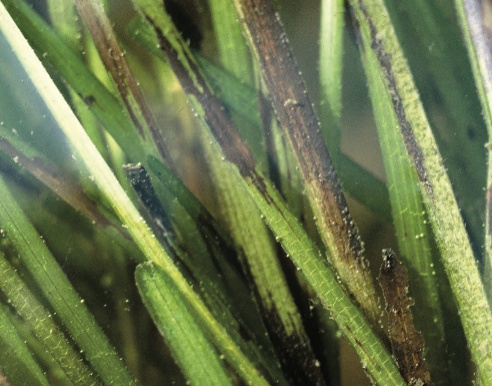
However, in the 1930s Seagrass meadows were hit pretty hard by the seagrass wasting disease. This disease is caused by the protist Labyrinthula zosterae which causes the seagrass to develop dark lesions on its blades which spread preventing it from being able to photosynthesise and can ultimately lead to the death of the plant. Stressed plants are much more susceptible to the disease, and this can be caused by increased temperature, agricultural run offs, sewage discharge and high nutrients causing algal blooms which block essential sunlight weakening the seagrass.
Oceanbites, 2021
Over the last century, we have seen losses of up to 92% of our seagrass meadows here in the UK which you can imagine is not ideal. Seagrass also face a range of other threats such as pollution, coastal development and physical disturbance from boats and fishing.
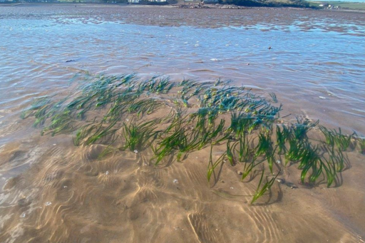
Luckily there has been a huge drive to try and restore some of our seagrass and there have been some major restoration projects working on this. One such project was done locally in Dale in 2020, where project seagrass along with Sky Ocean Rescue, Swansea university and WWF planted over 1.2 million seeds over 20000m². This was the UK’s first major seagrass restoration project and now seagrass in Dale is increasing in density and doing well.
Dale Seagrass Project, 2025
References
WWF (2023) Planting Hope: Seagrass Available at: https://www.wwf.org.uk/what-we-do/planting-hope-how-seagrass-can-tackle-climate-change
Unsworth, R.K.F., Furness, E.C. and Rees, S.R. (2022) Technical report on seagrass restoration in Dale, Pembrokeshire. Project Seagrass. Available at: https://www.projectseagrass.org/wp-content/uploads/2022/05/SOR-Technical-report-Dale-2022.pdf
Eisenlord, M.E., Yoshioka, R.M., Graham, O.J., Yang, B., Burge, C.A. and Harvell, C.D. (2024) ‘High infectivity and waterborne transmission of seagrass wasting disease’, Royal Society Open Science, 11(8), p. 240663. https://doi.org/10.1098/rsos.240663
Wales Biodiversity Partnership (2026) Seagrass. Available at: https://www.biodiversitywales.org.uk/en/species-in-wales/marine/seagrass/
Marine Life Information Network (MarLIN) ‘Zostera marina’. Available at: https://www.marlin.ac.uk/species/detail/1409
Marine Life Information Network (MarLIN) ‘Zostera noltii’. Available at: https://www.marlin.ac.uk/species/detail/1282
Pembrokeshire Coastal Forum (2020) Seagrass Dale 2 [Photograph]. Available at: Pembrokeshire Coastal Forum
Dale Seagrass Project (2025) Seagrass growing in Dale Bay [Photograph]. Available at: Dale Seagrass Project
Oceanbites (2021) Screen Shot 2021-08-26 at 7.57.33 AM [Image]. Available at: Oceanbites
Future Publishing Limited (2021) RcByJhXftLxcV6Ej4Zn2R3 [Photograph]. Available at: Future Publishing Limited image