
By Marine Conservation Intern Rose Dawson
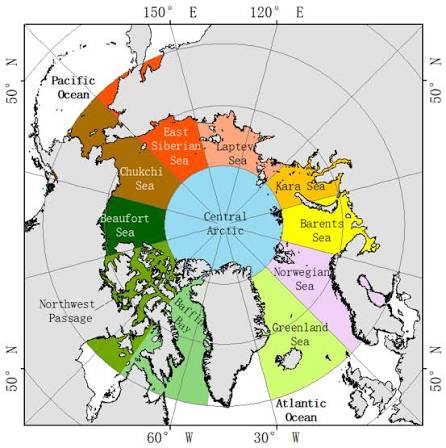
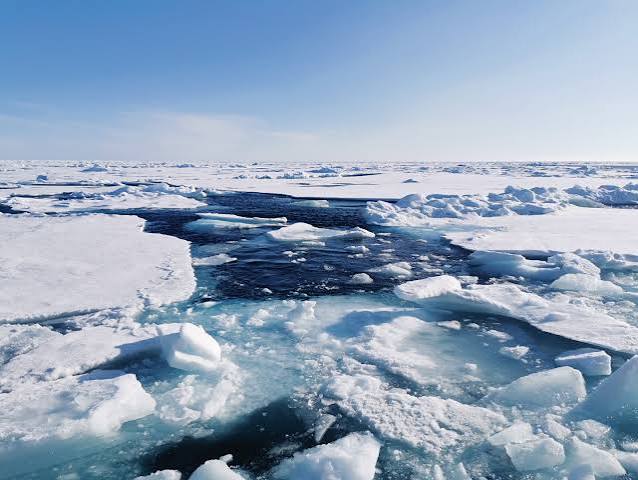
At the top of the world lies the Arctic Ocean, the smallest and shallowest of Earth’s five oceans, covering roughly 14 million square kilometres around the Geographic North Pole. For much of the year, a large part of its surface is locked beneath thick perennial sea ice, which makes ocean conditions here very extreme. Surface waters are often near freezing and dark, cold polar vortex conditions amplify bitter oceanic and atmospheric temperatures, and Earth’s tilt tips the area into months of continuous darkness in winter. Everything north of the Circumpolar Arctic Circle, at latitude 66°33′ N, falls within this zone.
Despite the cold, the Arctic Ocean still supports a rich but fragile ecosystem, made up of keystone species like the Arctic Cod, and also several cetacean species, including the incredible Bowhead (Balaena mysticetus) and Beluga (Delphinapterus leucas) whales. This blog will concentrate on these two cetaceans, and a speculated relationship between them.
The Bowhead and the Beluga differ enormously in size, anatomy and feeding styles – with one a colossal filter-feeding baleen whale, and the other a small, toothed, highly social hunter – yet the two are regularly recorded together in the same waters. Scientists have investigated some potential motives for this and aren’t totally sure, but one idea is really quite cute! Before we actually dive into this, let’s first look into the amazing individual characteristics of the two species.
The Bowhead Whale
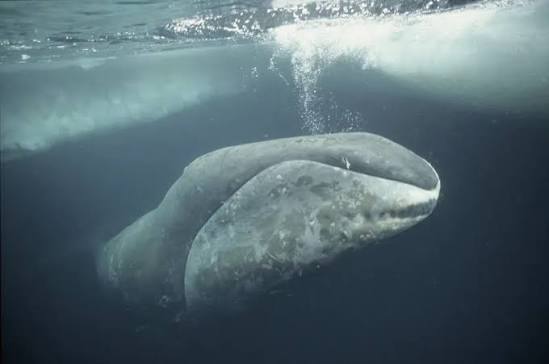
The Bowhead Whale (Balaena mysticetus) is the only baleen whale to spend its entire life in the Arctic and subarctic waters, meaning it is endemic to the region (only found there). Generally, five ‘stocks’ of Bowhead whales are considered to live in the 11 Arctic marginal seas, in waters like Baffin Bay, Svalbard and the Chukchi Sea. They are incredible cetaceans, and can be identified by their round body, exceptionally large, strong heads, and long, dark baleen plates. Their skin is mostly black, but they also have white patches around their flukes, tails, eyes and chins. They eat a diet mostly comprised of Zooplankton, and use their baleen plates – flexible, comb-like structures made of keratin which hang from their upper jaw – to filter feed.
Bowheads are impressive first, because they are enormous – in pretty much every sense. A fully grown adult can reach up to 59 feet long, roughly the length of a bus, and can weigh around 100 tonnes. Interestingly, Female Bowheads are the real giants, and are thought to be around 6 feet longer than males on average. They also have the largest mouth of any living animal, taking up a third of their whole body, and this mouth contains the longest baleen plates of any whale, up to 17 feet long! This means almost three grown men standing on each other’s shoulders can fit tucked inside a Bowhead Whale’s mouth. Even cooler than that, they are estimated to be the longest-lived mammals on the planet, at an insane 200 years old!
But here’s the really special part. The Bowhead is actually considered the last in its family. It’s the only living member of a group called Balaena, which makes it a lone wolf on its family tree. Scientists like Linnaeus argued for many years that bowheads are the same by appearance as Right Whales, but studies in the 2000s finally settled the debate: Right Whales are close relatives, but they sit on their own genus called Eubalaena, while the Bowhead stands alone in its own genus Balaena. Interestingly, the last ancestor of the Bowhead is considered by scientists to be a species called Morenocetus, which lived until around 23 million years ago before it went extinct, so the Bowhead really is the last whale standing in a very old family tree.
Furthermore, arguably the most remarkable thing about the Bowhead is its call. Humpback whales are famous for their whale songs, but some oceanographers are now coining the Bowhead as the “jazz singer” of the sea – and their scientific findings support this claim. Between 2010 and 2014, Kate Stafford, who is principal oceanographer at the University of Washington, lowered an underwater microphone into the Fram Strait off Greenland and recorded a population of around 300 Spitsbergen Bowheads, singing a whopping 184 different song types. Stafford’s leading explanation for this is environmental, and she thinks that Bowheads sing through the polar winter in near-total darkness and heavy sea ice – and because they’re the only large whale in the Arctic – they don’t need a fixed song to identify their species, leaving them free to keep inventing new ones for fun. These songs were found to change many times interannually and are thought to be much more complex than those of Humpbacks. Humpbacks generally sing the same recognisable song one year, and change it the next, but Stafford found that Bowheads sing many different songs to each other within the same year, which is remarkably rare among mammals! The “jazz” comparison is also quite precise, as Bowheads are thought to produce these sounds by cycling air between their lungs and a sac near the windpipe as they breathe, similar to the circular breathing a saxophonist uses to hold a note!
The Beluga Whale
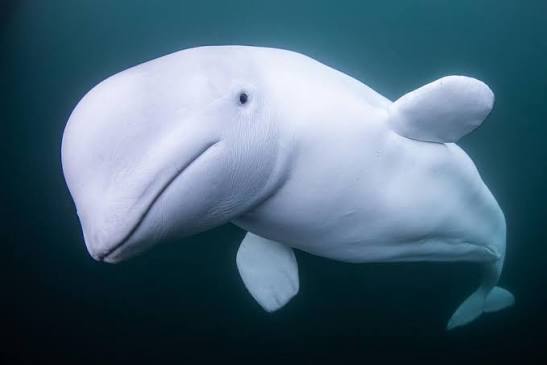
Now meet the Bowhead’s unlikely friend: the Beluga (Delphinapterus leucas). The Beluga is one of the two living members of the family Monodontidae, along with the Narwhal, and is the only member of the genus Delphinapterus. Belugas are known as the ‘white whales’, as they are the only cetaceans to regularly occur with this pigmentation, except for when they are babies and are grey. They are small and have a fusiform-shaped body (cone-shaped with the point facing backwards) and have a rounded melon-like forehead and a permanent half-smile. They are mid-sized members of the toothed whale population, and adult males regularly grow to around 11–18 feet, with females usually around 25% shorter. The biggest males can even weigh up to 1,600 kg and are sustained by a diet of of fish (Arctic Cod, Salmon and Herring), eaten using teeth like dolphins and Orca.
Their incredible white pigmentation – which helps them blend into sea ice and avoid predation – is also one of the many clever adaptations that they have for life in the bitterly cold Arctic. They are physiologically adapted to life there, as unlike most other cetaceans, they have no dorsal fin, which means nothing snags or scrapes as they swim along beneath the ice, and so they can glide with ease. They can also swim backwards, which is rare for cetaceans, and this helps them navigate the icy underwater environment and dodge predators if necessary. They are also well-adapted to survive the freezing water, as an enormous 40 to 50 percent of their body weight is blubber, which wraps them in a nice layer of 15 centimetres of fat, far more than whales living in warmer seas have. This fat is seen externally as folds and acts as an insulation layer in waters of temperatures between 0 and 18 degrees Celsius. This fat is also an important reserve during periods without food, particularly their migration seasons outside of the winter and spring periods, which have been observed by Inuit populations as the months in which Belugas eat the least.
Finally, Belugas have two nicknames that capture their personality perfectly. The first is “Sea Canary,” earned through their incredible range of squeaks, whistles, clicks and chirps, which have had them recognised as some of the chattiest animals in the entire ocean, and their hearing, which is so sharp they can pick up sounds far beyond what human ears can detect. Their auditory cortex – which is the sound-processing region of their brain – can pick up sounds within the range of 1.2 to 120 kHz, mostly received (we think) by the lower jaw and transmitted towards the middle ear. All of that occurs within the Beluga’s very large and complex brain, which is the source of the whale’s second, and quite popular, nickname: “Melonhead”.
The name Melonhead comes from the soft, rounded bulge on a Beluga’s forehead, called a melon, which gives the whale its distinctive domed, cute, almost cartoon-like look. The melon is amazing and holds a pocket of fatty tissue that Belugas use to focus their clicks into a narrow beam of sound, sending them out into the water ahead. When those clicks bounce off a fish, a chunk of ice or the seabed, the echoes return, and the Beluga reads them to build a picture of its surroundings, a phenomenon known as echolocation. Remarkably, the Beluga can even change the shape of its melon if it needs to, squishing and flexing it to aim sound in different directions! In the lightless Arctic winter, where their eyes are of little use, this method lets Beluga hunt effectively, navigate the ocean, and also find precious gaps in the ice to breathe, almost entirely by sound. However, finding sections of melted ice to breathe through can be tricky even with echolocation powers, so sometimes Belugas may need a little bit of a helping hand from their larger neighbours.
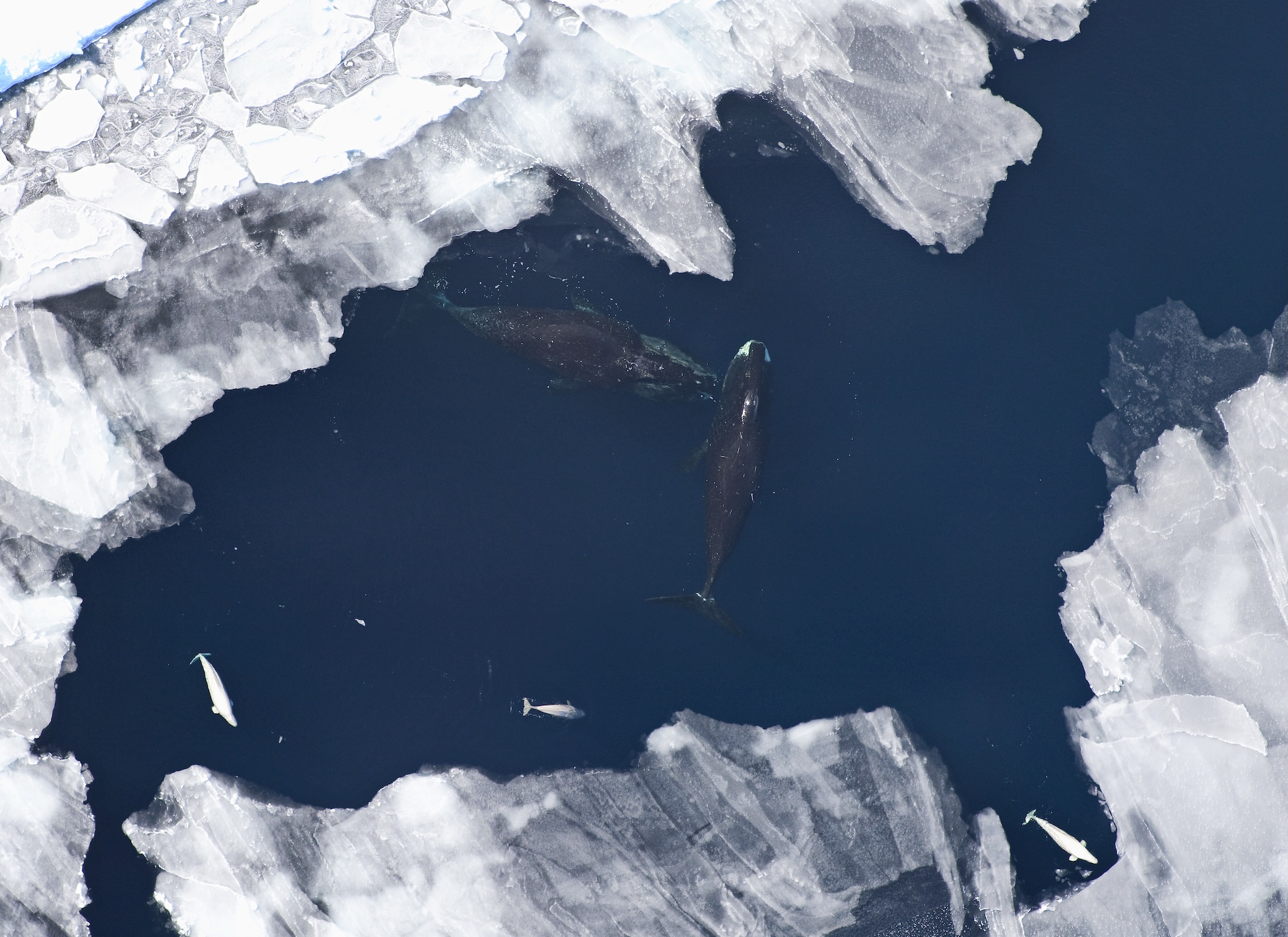
So, what could be bringing these cetaceans together?
The need to breathe!
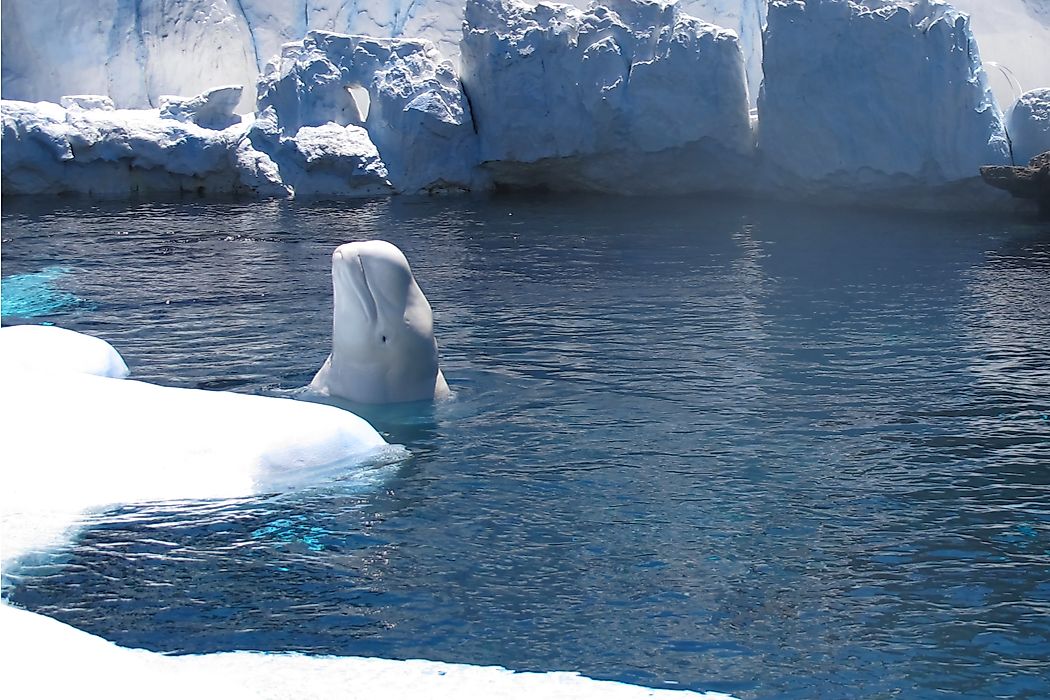
Belugas are mammals, just like us, which means they don’t have gills and must return to the ocean’s surface for every breath. They are superbly equipped to hold their breath, but thick Arctic ice can sometimes pose as a pretty stressful obstacle course! A diving Beluga is designed to slow its heart rate from around 100 beats per minute to as few as 12, and when it descends, it reroutes its blood to the organs that need oxygen most, so can stay down for 20 minutes maximum. However, no amount of breath-holding skill changes the basic rule that eventually, they must come up for air, and in the depths of the Arctic winter, surfacing can prove tricky despite incredible echolocation skills. The ocean freezes into a thick, unbroken ice sheet, leaving only scattered cracks and gaps in a wide stretch of ice-plains. This means that there are a limited number of spots to surface through, and Belugas need to time their breathing just right. This precarious situation is therefore something that may have caused them to follow Bowheads, and thus led them to develop a very clever trick.
Bowheads to the rescue!
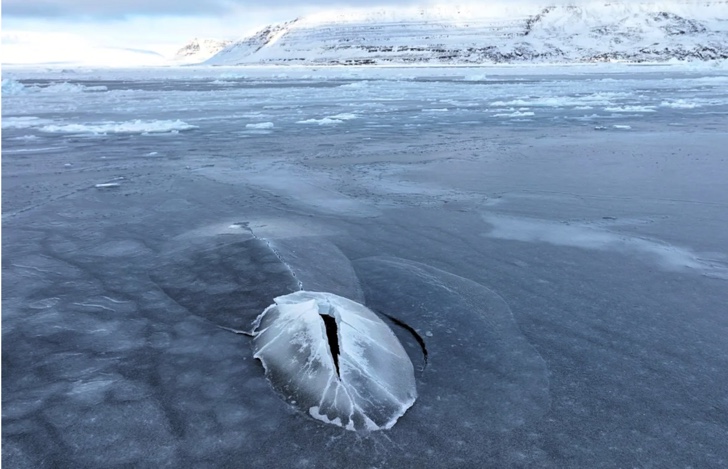
This is where Bowheads come in. Bowheads can dive for much longer than Belugas – up to an hour – and are designed to be able to break ice at speed when they surface. Where the Beluga’s head is soft, the Bowhead’s is built like an enormous battering ram, as they have a colossal, reinforced skull that makes up a huge proportion of their body, and can use this to batter the thick ice from below. Astonishingly, they can break sea ice as thick as two feet, creating a passage to the air above. By doing this, they create precious patches of access to the atmosphere in an otherwise sealed-over sea – called a ‘polynya’ – and allow themselves to breathe after very long dives, instead of getting stuck and into a pickle like other cetaceans, as the Beluga might.
And this is one of the theories for why Belugas and Bowheads are often seen together. Belugas and Bowheads are repeatedly recorded in the same waters – aerial surveys and satellite tracking show their ranges overlapping again and again – and one speculation is that Belugas share the polynyas their giant neighbours create, something they could never break open on their own.
The two are a very unlikely and cool match, as Bowheads are generally solitary giants that travel alone or in very small pods of up to six animals, have different diving capacities, and feed in a totally different way and on totally different prey, so they are otherwise unlikely to encounter Beluga. Very cleverly – if this theory is proven – Belugas will have learnt to adopt themselves into the Bowhead’s social circle, for the purely biological impulse of survival. Bowheads break the ice for themselves, and Belugas tag along. Questions over why Bowheads and Belugas are seen together are being asked more and more, with organisations such as NOAA fisheries increasingly using satellite tracking and spatial-modelling studies to map exactly where the two species overlap across the ice. Most commonly, these images have successfully recorded pairings in the Beaufort Sea, which is the stretch of the Arctic Ocean off the north coast of Alaska and northwest Canada and have revealed that Bowheads and Belugas may share and divide up their frozen habitats, with the breathing-hole theory a compelling observation that scientists are still working to understand. It has also been suggested that the two feed near one another and may keep a shared watch for predators like Orca. This means that the Bowhead may not only offer the Beluga air sanctuaries, but also safety in numbers. Scientists are careful to call these benefits a likely advantage rather than a proven biological relationship, but the pattern is very hard to ignore!
Relationship Longevity
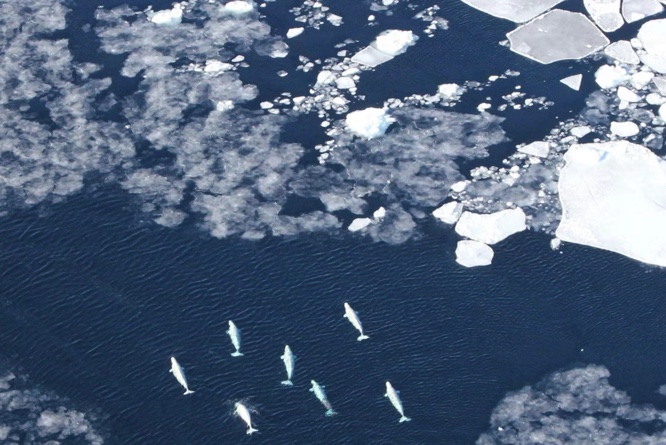
The Bowhead and the Beluga are an interesting example of very different species that may have found in one another a really cool survival strategy. What began as one whale’s need for air has possibly become a cute companionship that supports life and deters predators. As the Arctic climate warms rapidly through arctic amplification, and sea ice continues to thin and retreat, it will be fascinating to see if this partnership survives under changing conditions, and what further research this might bring. The question is: will the Beluga still need the Bowhead?
For now anyway, this friendship remains yet another of the ocean’s incredible social stories, and is a reminder of how much there still is to learn about changing life in the Arctic.
Sources
Stafford, K. M., Lydersen, C., Wiig, Ø. & Kovacs, K. M. (2018). “Extreme diversity in the songs of Spitsbergen’s bowhead whales.” Biology Letters, 14(4). https://royalsocietypublishing.org/doi/10.1098/rsbl.2018.0056
NOAA Fisheries. “5 Icebreakers About Bowhead Whales.” https://www.fisheries.noaa.gov/alaska/outreach-and-education/5-icebreakers-about-bowhead-whales
NOAA Fisheries. “Bowhead Whale” (species page). https://www.fisheries.noaa.gov/species/bowhead-whale
NOAA Fisheries. “International Survey Counts Bowhead and Beluga Whales in the Beaufort Sea.” https://www.fisheries.noaa.gov/feature-story/international-survey-counts-bowhead-and-beluga-whales-beaufort-sea
NAMMCO (North Atlantic Marine Mammal Commission). “Bowhead Whale.” https://nammco.no/bowhead-whale/
Natural History Museum (London). “Beluga whales: social, smart and wizards with sound.” https://www.nhm.ac.uk/discover/beluga-whales.html
Wikipedia. “Bowhead whale.” https://en.wikipedia.org/wiki/Bowhead_whale
Wikipedia. “Beluga whale.” https://en.wikipedia.org/wiki/Beluga_whale
Oceanwide Expeditions – Bowhead Whale
https://oceanwide-expeditions.com/to-do/wildlife/bowhead-whale